(904) 902-0927

Diagnose · hard-water ice maker

Scale-Choked Sub-Zero Ice Makers in St. Johns

Cubes getting smaller season by season is not a dying machine — it is the county’s water. Here is how to tell scale from a real fault, and what the fix involves.

In St. Johns and Julington Creek the supply tests 14 to 28 grains per gallon, the hardest in the Jacksonville metro, and that mineral load is what shrinks Sub-Zero cubes. Scale attacks the fill tube and inlet valve before the mold ever fails. A descale-and-rebuild typically runs $250 to $650, quoted before any work starts.

To book Sub-Zero repair in St. Johns, Julington Creek, Fruit Cove, or Durbin Crossing, call Sub-Zero Service St. Johns at (904) 902-0927 or book online for a two-hour window.

We are Sub-Zero Service St. Johns, an independent shop covering the 32259 corridor; reach dispatch at (904) 902-0927 or schedule through our external online booking page. On a unit still under factory warranty we will say so and route you to Sub-Zero® Factory Certified Service first. Updated June 13, 2026.

The essentials

Plain answers on scaled ice

Who diagnoses a scaled Sub-Zero ice maker in St. Johns?

Sub-Zero Service St. Johns runs a diagnostic-first workflow built around 32259 water — call (904) 902-0927 or use the external booking page. We see this fault more than any other, so the truck carries descaling gear plus the common inlet valves and filters.

What does the diagnosis cost?

A flat diagnostic covers a water-flow read at the valve, an inspection of the fill tube and filter, and a cube-size check; it rolls into the repair. A descale and rebuild typically lands $250 to $650. A new module, only when truly needed, is quoted separately.

Can I slow the scale down myself?

Changing the filter on a realistic interval helps, and softened or whole-house-filtered water helps a lot. We measure your flow at the visit and set a descale and filter cadence to your street rather than the box label, and we will tell you honestly whether a softener tie-in is the better long-term move.

On the record

Hard-water facts that decide ice

  • St. Johns water runs 14 to 28 grains per gallon — rated “very hard,” among the highest in Florida, peaking near St. Johns Forest and the CR-210 corridor.
  • Scale targets three parts in order: the fill tube, the water inlet valve solenoid, then the mold itself.
  • Sub-Zero rates its water cartridge near a year, but very hard water often exhausts one in six to nine months.
  • A descale-and-rebuild typically runs $250–$650; a full module replacement only when the hardware, not the scale, has failed.
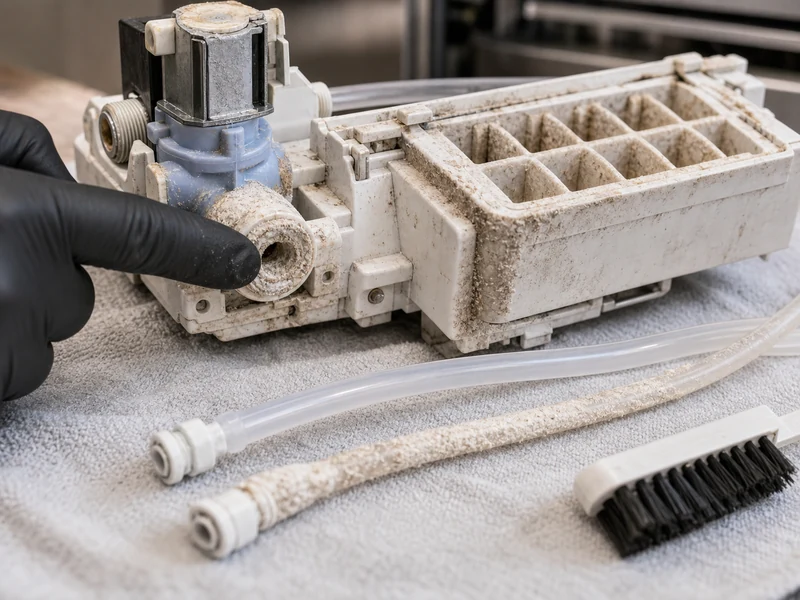
Mineral scale crusting the fill tube and mold of a Sub-Zero ice maker pulled from a St. Johns Forest home

How to read the scale symptoms

Hard-water failure is a slow slide, and it follows a predictable order. First the cubes lose size and go hollow as the narrowed fill tube delivers less water. Then harvests stretch further apart because the stiffening inlet valve cannot open fully. A white, chalky crust on the fill tube and around the mold confirms the story — the hardware is sound, the water is the problem.

That is the opposite of a real module failure, which tends to be sudden or noisy. When the decline is gradual and the water path shows mineral, descaling is the answer. The full repair walk-through lives on the ice maker repair page, and the chemistry behind it is in the hard water guide.

Scale symptom → part affected → cost lane
What you see Part the scale hit Typical cost lane
Cubes small, hollow, cloudy Narrowed fill tube, early valve scale $250–$450
Long gaps between harvests Inlet valve solenoid not opening fully $350–$650
Off taste or odor in the ice Exhausted filter, standing scale $150–$350
White crust on tube and mold Heavy scale across the water path $300–$650

Ranges cover parts and labor; we measure flow before deciding which lane applies.

What we actually do

Confirming scale before we touch a part

  1. Measure water flow at the inlet valve and compare it against spec to separate scale from hardware.
  2. Inspect the fill tube and mold for the telltale chalky crust.
  3. Check filter age against its rated gallons and your local hardness.
  4. Flush the line, clear the tube, and replace the valve only if flow stays low after cleaning.
  5. Run a full harvest, verify cube size and weight, and set a maintenance interval to your street.

Water condition → evidence → recommendation

Matching the fix to your supply
Home water Evidence at the valve Recommendation
Untreated 14–28 gpg Heavy crust, fast filter exhaustion Descale plus a 6–9 month filter cadence
Softened or whole-house filtered Light scale, near-normal flow Annual filter, periodic descale check
Older home on legacy well Iron or sulfur staining, not just scale Pre-treat the supply, then service the unit

Tell them apart

Scale versus the faults it gets blamed for

Scale is the common cause in 32259, but a few other faults shrink or stop ice and get mistaken for it. The difference is in the onset and the look of the cubes, and naming the right one to dispatch sends the correct part on the first truck.

What you see → scale or something else → the giveaway
What you see Scale or something else The giveaway
Cubes shrink slowly over months Hard-water scale Chalky crust on the fill tube, gradual decline
Ice stops abruptly, no warning Frozen fill tube or failed valve Sudden onset, no crust — a heater or solenoid
Cubes clump or fuse together Slow harvest or a clogged drain Cubes are full size but welded, not small
Ice is discolored or smells off Well-water iron or sulfur Color and odor, not size — an upstream supply issue

The well-water case is its own neighborhood story on the Fruit Cove ice maker page; the full repair runs through the ice maker repair page.

Local notes

Why scale is the defining St. Johns ice fault

No place in the metro hits an ice maker harder than this county. The limestone Floridan aquifer pushes hardness toward 28 grains per gallon near St. Johns Forest and the CR-210 corridor, and an ice maker runs water through tight passages on every single harvest — so it feels that load before any other appliance in the kitchen does. Add a ten-month cooling season that keeps the machine working, and the decline arrives faster than owners expect.

The housing cohort reinforces it. The Classic BI built-ins that fill Durbin Crossing and Aberdeen are now well into their scaling years, and a few older Fruit Cove properties still draw legacy well water, which stains the ice with iron or sulfur instead of shrinking it — a different fix that starts upstream of the fridge. Either way, the diagnosis begins with a flow read, not a parts swap.

Diagnostic case note — Durbin Crossing

Educational diagnostic scenario. A Durbin Crossing household reported cubes shrinking to a third of normal over a summer. Flow at the valve read well below spec, the fill tube was crusted, and the filter had run months past its gallons. We flushed the line, cleared the tube, swapped a valve that stayed sluggish, and changed the cartridge. Full cube weight returned the same visit, with a six-month descale interval set against the local hardness.

Hard-water FAQ

Questions about scale and shrinking cubes

How do I know it is scale and not a broken ice maker?

The pattern gives it away. Scale fails gradually — cubes shrink and go hollow over months, harvests stretch further apart, and a white crust appears on the fill tube. A genuinely broken module fails abruptly or makes noise. When the decline is slow and the water path shows mineral crust, it is hard water nine times out of ten.

Which part does the scale attack first on a Sub-Zero?

The fill tube and the water inlet valve solenoid take the first hits, in that order. Mineral narrows the tube so less water reaches the mold each cycle, then it stiffens the valve so it cannot open fully. The mold and harvest mechanism are usually fine — by the time they are affected, the upstream parts have been struggling for a while.

Will descaling fix it, or do I need new parts?

Descaling alone fixes a large share of these, especially when caught early. We flush the line, clear the fill tube, and measure flow; if the valve still reads low after cleaning, we replace just that part. A full module swap is rare and only justified when the hardware itself, not the scale, has failed.

How quickly will scale come back after a service?

That depends on your water and your maintenance interval. Untreated 14-to-28-grain supply rebuilds scale within a year or two; a softener or whole-house filter stretches that out considerably. We set a descale and filter cadence matched to your specific street so the ice maker does not slide back into the same decline.

Is hard-water scale covered like a normal repair visit?

Yes. A descale-and-rebuild is a standard diagnostic-and-repair visit: the flat diagnostic covers the flow read and inspection and rolls into the work. Most land $250 to $650. If your unit is still under factory warranty we will check the serial and tell you, since routine maintenance and out-of-warranty work are what we handle.

Could a frozen fill tube look like scale on a Sub-Zero?

It can, and the two are worth separating. Scale narrows the fill tube gradually and leaves a chalky crust, while a frozen fill tube blocks it suddenly, usually because a fill-tube heater failed or a draft froze the water before it reached the mold. Both starve the cubes, but one is a descale and the other is a heater. We thaw and inspect the tube before deciding which it is.

How much can scale cut my ice output before the maker quits entirely?

Quite a lot, and it happens by degrees. As scale narrows the fill path, cube size and harvest volume drop steadily — many homes lose a third to half their output over a single hard-water year before the inlet valve finally scales shut and production stops. That slow taper is the warning window; catching it during the decline keeps the fix a descale rather than a valve replacement.

One call. A window that holds. A Sub-Zero back at 38°F and 0°F.

Weekdays 7:30 am–7 pm · Saturday 8 am–2 pm