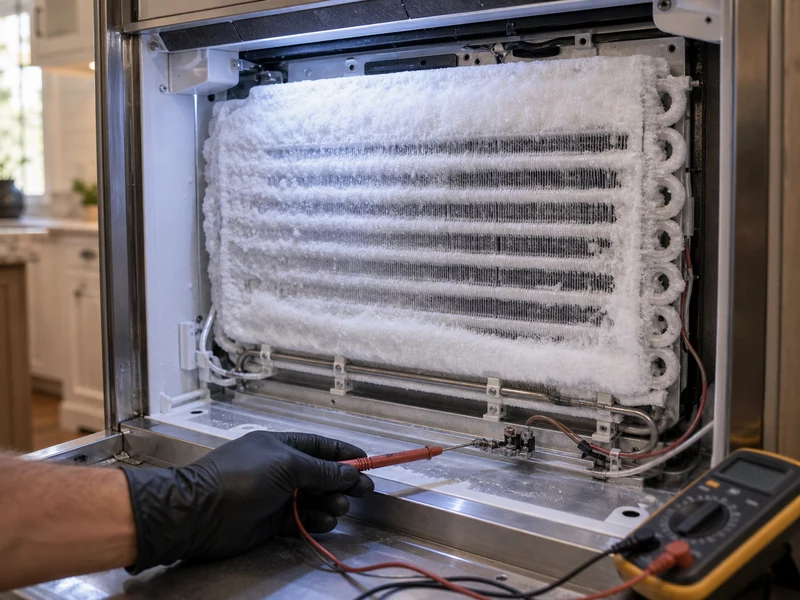
Why does frost keep building on my Sub-Zero freezer back wall?
A frost sheet climbing the rear wall means the defrost cycle has stopped clearing the evaporator. The usual culprit is a failed defrost heater or its thermostat, sometimes the bimetal or a control fault that never triggers the cycle. Ice then blankets the coil, airflow drops, and the freezer slowly warms even though the compressor runs.
My freezer is warm but the refrigerator is fine — what failed?
That split usually points to the freezer evaporator: an iced-over coil from a dead defrost heater, or a failed freezer evaporator fan that has stopped moving cold across it. Because each side of a built-in cools independently, a warm freezer with a healthy fridge rarely means a sealed-system problem. We confirm before quoting.
Is partial frost on the coil a sign of a refrigerant leak?
It can be. When only the first few inches of the evaporator frost over and the rest stays bare, that uneven pattern is a textbook sealed-system leak, especially on older units. We read pressures before we say a word about it, because that repair runs $1,500 to $3,000 and deserves real evidence, not a guess.
There is a sheet of ice in the bottom of my freezer — why?
A clogged defrost drain. Melt water from the defrost cycle cannot reach the pan, so it refreezes on the floor and eventually seeps out the door. We clear and flush the drain, check the heater that keeps it open, and verify it carries water away cleanly before we leave.
How long does a typical freezer repair take?
Most defrost and fan repairs are a single visit when the part is on the truck, and we stock the common Classic BI components. After any repair the freezer needs a full 24 hours to pull back down to 0°F and hold, so we set expectations and tell you what a healthy recovery curve looks like.
How can I tell a bad defrost heater from a failed evaporator fan?
Read the coil. A dead defrost heater leaves the evaporator buried under an even sheet of frost, because the melt cycle never fires. A failed evaporator fan leaves the coil mostly clear but the freezer warm, because the cold is being made and not moved. We confirm with a meter on the heater and a clamp on the fan, but the frost pattern usually tells the story on sight.
My Sub-Zero freezer is making a loud buzzing or rattling noise — what is it?
A freezer that suddenly buzzes or rattles is usually the evaporator fan blade catching frost from a stalled defrost cycle, or a fan motor bearing on its way out. Less often it is the condenser fan below. We pin down which fan by location and draw, then replace the motor or clear the ice that is hitting the blade, and verify the cabinet pulls back to 0°F.
After a power outage my freezer is warm — does it just need to reset?
Sometimes a Sub-Zero restarts on its own and recovers within 24 hours. But Northeast Florida restoration surges can lock or kill the control board, leaving the freezer dead with the lights on. If it has not begun pulling down after a full day, the storm likely took the board, not just the power. Move anything irreplaceable to a cooler and call dispatch.
Can I just keep manually defrosting instead of fixing the heater?
You can buy a day or two that way, but it is not a fix. Manually melting the frost off the coil restores airflow briefly, then it stacks right back up because the defrost cycle still is not firing. Each round also stresses food and the gasket. On a Classic BI the heater and thermostat are inexpensive parts, so the repair costs less than living with the workaround for a season.
My freezer holds 0°F but the ice cream is still soft — what gives?
A thermometer on the shelf can read 0°F while the air is not circulating, which leaves warm pockets near the door. That points to a weak or stalling evaporator fan rather than the cooling itself, or a gasket letting warm air in low. We map the temperature at several points and meter the fan; uneven cold with a healthy compressor is an airflow fix, not a sealed-system one.