(904) 902-0927

Water & care · guide

The St. Johns Hard Water Guide for Sub-Zero Owners

If you own a Sub-Zero in this county, the water it drinks is the single biggest factor in how long the ice maker lasts. Here is what 28-grain water does, and how to stay ahead of it.

St. Johns County draws limestone-aquifer water that tests 14 to 28 grains per gallon — the hardest in the Jacksonville metro, peaking near St. Johns Forest and the CR-210 corridor. That mineral load scales Sub-Zero ice makers and exhausts filters early. Descaling every six to twelve months and a matched filter cadence keep it in check.

To book Sub-Zero repair in St. Johns, Julington Creek, Fruit Cove, or Durbin Crossing, call Sub-Zero Service St. Johns at (904) 902-0927 or book online for a two-hour window.

This guide comes from Sub-Zero Service St. Johns, an independent shop covering St. Johns, Julington Creek, Fruit Cove, and Durbin Crossing in ZIP 32259; reach dispatch at (904) 902-0927 or schedule through our external online booking page. We are not Sub-Zero® factory service — on a unit still under warranty we will say so and point you to the right door. Updated June 13, 2026.

The essentials

The short version of a long water story

How hard is St. Johns water, really?

Very hard, by any standard. The threshold for "very hard" sits around 10.5 grains per gallon; St. Johns runs 14 to 28, so the supply here is two to nearly three times that line. It is among the highest in Florida, and the hardest readings in the whole metro land in the northwest of the county.

Why does it matter for a Sub-Zero?

Because the ice maker runs household water through tight passages on every harvest. The dissolved minerals plate out as scale on the fill tube, the inlet valve, and the mold, and they push the water filter past its useful life early. No other appliance in the kitchen feels the hardness as directly.

What keeps it from becoming a repair?

A maintenance rhythm matched to your water: descaling on a six-to-twelve-month interval, a filter change every six to nine months on untreated supply, and softened or whole-house-filtered water where it makes sense. Stay ahead of the buildup and the ice maker keeps making full cubes for years.

On the record

Hard-water numbers that hold up

  • St. Johns supply tests 14 to 28 grains per gallon — the metro’s hardest — from the limestone Floridan aquifer.
  • "Very hard" begins near 10.5 gpg, so local water sits two to nearly three times above that threshold.
  • A Sub-Zero water cartridge is rated near a year but often exhausts in six to nine months on this supply.
  • Scale attacks the water path in order: fill tube first, inlet valve solenoid second, the mold last.
  • A descale-and-rebuild visit typically runs $250–$650; staying on a maintenance interval avoids most of it.
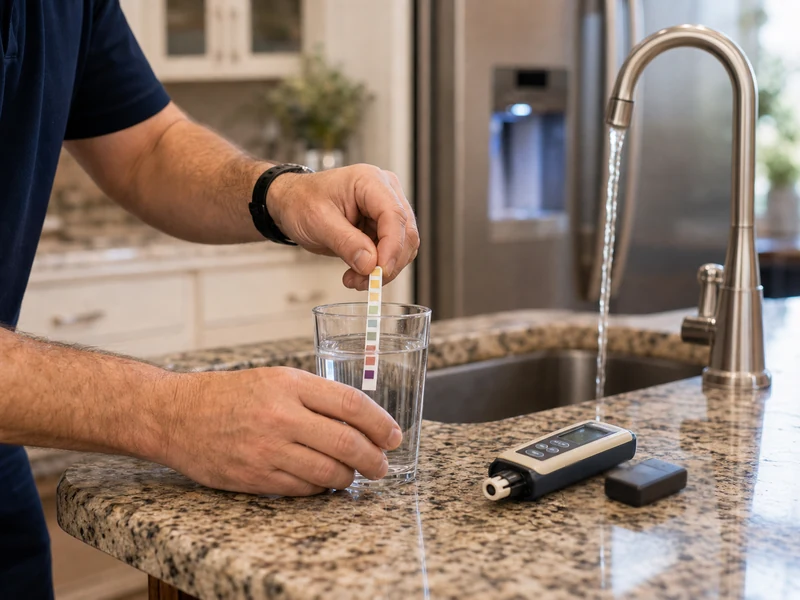
Technician measuring supply water hardness at a kitchen tap in a St. Johns Forest home

What scale does, step by step

Hardness is dissolved calcium and magnesium, and every fill cycle leaves a little behind. On the fill tube it builds a chalky ring that narrows the bore, so the mold receives less water than it is timed for and cubes shrink and go hollow. On the inlet valve solenoid it stiffens the mechanism, so the valve cannot open fully and harvests stretch further apart.

The water filter, meanwhile, exhausts faster than its rated gallons because it is straining against a heavy mineral load every day. Once it is spent it stops protecting the ice maker at all, and the decline accelerates. The repair side of this story lives on the hard-water ice maker diagnostic and the ice maker repair page.

Hardness level → what you notice → what to do
Supply condition What you notice What to do
Untreated 14–20 gpg Cubes shrinking over a couple of seasons Descale yearly, filter every 6–9 months
Untreated 20–28 gpg (NW county) Fast cube decline, early filter exhaustion Descale twice a year, consider treatment
Whole-house softened or filtered Light scale, stable cube size Annual filter and a periodic descale check
Legacy private well Discolored or sour ice, not just small Pre-treat for iron or sulfur upstream first

Intervals are starting points; we set yours to the flow we measure at the valve.

What you can do

An owner’s hard-water routine

  1. Change the Sub-Zero water cartridge on a six-to-nine-month interval rather than waiting a full year.
  2. Watch cube size and clarity as your early warning — shrinking, hollow cubes mean scale is winning.
  3. Have the water path descaled before the decline gets steep; it is cheaper than letting a valve fail.
  4. If you are already considering a whole-house softener, route it to cover the kitchen line.
  5. On an older Fruit Cove lot, test for well-water iron or sulfur, which needs treatment a filter cannot provide.

Treatment option → what it fixes → the trade-off

Weighing your water options
Option What it fixes The trade-off
Fridge filter only Taste and particulates Does not soften; exhausts early in this water
Periodic descaling Existing scale in the water path Recurring; needed on any untreated supply
Whole-house softener Hardness at the source, whole home Upfront and maintenance cost; worth it system-wide
Well pre-treatment Iron and sulfur staining Only for homes on a private well

The chemistry

Why scale speeds up once it starts

Scale is precipitated calcium carbonate — the same limestone the aquifer dissolves, re-forming as a solid wherever water sits, warms, or evaporates. That is why an ice maker is the worst victim: water pauses in the fill tube and mold on every cycle, and each pause lets a little more mineral drop out of solution and bond to the surface. The deposit is not just cumulative, it is self-accelerating — a rough scaled surface gives the next layer more to grab, so a tube that took a year to narrow halfway can choke the rest of the way in a few months.

Two local factors push that curve steeper. The first is raw hardness: at 14 to 28 grains per gallon, every gallon carries two to nearly three times the mineral of merely “hard” water, so each cycle deposits more. The second is the ten-month cooling season, which keeps the machine cycling water far more of the year than a northern climate would. Together they explain why owners here describe an ice maker “suddenly” failing — the buildup was linear for a long time, then crossed the threshold where flow collapsed.

Stage of scale → what is happening → what you would notice
Stage What is happening What you notice
Early A thin ring forms in the fill tube Nothing yet — cubes still full size
Building The bore narrows; the valve begins to stiffen Cubes shrink, go hollow, harvests slow
Advanced Flow drops sharply as the surface roughens Production tapers fast over a single season
Failure The inlet valve solenoid scales shut No ice; the harvest cycles on no water

Catching the problem at the “building” stage keeps it a descale; reaching “failure” usually adds a valve, as the hard-water ice maker diagnostic lays out.

A worked year

One untreated ice maker, twelve months

It helps to see the calendar play out. Picture a Classic BI in an Aberdeen kitchen on untreated supply near the top of the local range, with a filter installed last spring and no descaling since. Here is the year that follows, and where a single well-timed visit changes the ending.

  1. Spring: a fresh cartridge goes in; cubes are full and clear, flow at the valve reads normal.
  2. Early summer: a thin ring is already forming in the fill tube, invisible from the kitchen.
  3. Mid summer: peak ice demand meets a half-rated filter; cubes start shrinking and going hollow.
  4. Fall: harvests stretch further apart as the inlet valve stiffens; the filter is months past its gallons.
  5. The following spring: flow collapses and production all but stops — now a descale plus a valve.

Slot a descale and a filter change into that fall window and the story ends at step three instead of step five: a $250-to-$650 maintenance visit rather than a stiffened valve and a starved machine. That is the whole argument for a cadence matched to this water, and it is the visit detailed on the ice maker repair page.

Local notes

Where the hardness peaks in St. Johns

Hardness is not uniform across the county. The dissolution of the limestone aquifer runs heaviest in the northwest — near St. Johns Forest and along the CR-210 corridor — where readings push toward the 28-grain top of the range. Homes in Durbin Crossing, Aberdeen, and Julington Creek Plantation sit in that band, which is exactly why the scaled ice maker is the most common single call we run.

Fruit Cove adds the one exception worth knowing. Most of the area is on the same hard JEA supply, but a band of older riverside lots historically drew private-well water carrying iron and sulfur. That stains and sours ice rather than shrinking it, and no fridge filter or descaling fixes it — the answer is treatment upstream of the refrigerator. We test the tap before assuming which problem a home has, and the neighborhood split is detailed on the Fruit Cove ice maker page.

Diagnostic case note — St. Johns Forest

Educational diagnostic scenario. A St. Johns Forest household, in the county’s hardest band, called after the ice maker slid from full cubes to almost nothing inside a single summer. A tap reading sat near the top of the local range; the fill tube and valve were crusted and the filter long spent. We flushed and rebuilt the water path, replaced a stiffened valve, fitted a fresh cartridge, and set a twice-yearly descale interval against the measured hardness. Full cube weight returned that visit.

Hard-water FAQ

Questions about St. Johns water and your Sub-Zero

What does 28 grains per gallon actually mean in plain terms?

Grains per gallon measures dissolved minerals, mostly calcium and magnesium. Anything above about 10.5 gpg is rated "very hard"; St. Johns runs 14 to 28, so the supply here is two to nearly three times that threshold. Every gallon through an ice maker or filter leaves a measurable mineral deposit, which is why scale builds so fast.

Why is St. Johns County water harder than the rest of the metro?

It draws from the limestone Floridan aquifer, and limestone is calcium carbonate — the source of the hardness. The dissolution is heaviest in the northwest part of the county near St. Johns Forest and the CR-210 corridor, where readings push toward the top of the range. Neighboring areas tap the same aquifer but rarely as hard as here.

Will a refrigerator water filter handle hardness on its own?

Not for long. A Sub-Zero cartridge improves taste and catches particulates, but it is not a softener and does not remove the dissolved minerals that cause scale. In 14-to-28-grain water it also exhausts faster than its rated year, often in six to nine months, after which it protects the ice maker even less.

Is a whole-house softener worth it just for the Sub-Zero?

For the appliance alone it is overkill, but most homes that install one do it for the whole plumbing system and the Sub-Zero benefits as a bonus. Softened water dramatically slows scale at the ice maker valve, filter, and mold, and softened homes call us for ice problems far less. We can advise where the line should tie in.

How often should I have a Sub-Zero descaled in this water?

On untreated 14-to-28-grain supply, a descale every six to twelve months keeps the ice maker ahead of the buildup, paired with a filter change every six to nine months. Softened or whole-house-filtered homes can stretch to annual service. We set the exact interval to your measured flow rather than a generic label.

Does hard water hurt anything besides the ice maker?

The ice maker takes the worst of it because it cycles water constantly, but scale also clogs water dispensers and shortens filter life across the board. It does not directly harm the sealed cooling system, which uses no household water. Still, a unit fighting a scaled water path runs less efficiently, so addressing it pays off.

Does the hardness change with the seasons here?

It can shift modestly. Floridan-aquifer hardness is fairly steady, but heavy summer pumping and drought drawdown can nudge mineral concentration up, and the northwest of the county near St. Johns Forest already sits at the top of the range. The practical takeaway is to descale before summer rather than after, so the ice maker enters peak demand with a clean water path.

Is bottled or reverse-osmosis water plumbed to the fridge a real fix?

For the ice maker specifically, an under-sink reverse-osmosis line is one of the most effective options, because it strips the dissolved minerals before they ever reach the fill path. The trade-offs are install cost and a slower fill rate, which can stretch harvest times on a high-demand household. A whole-house softener protects more of the home, but RO plumbed to the kitchen line is the surgical fix for scale.

One call. A window that holds. A Sub-Zero back at 38°F and 0°F.

Weekdays 7:30 am–7 pm · Saturday 8 am–2 pm