(904) 902-0927

Refrigerator repair

Sub-Zero Refrigerator Repair in St. Johns

A warm fresh-food side the morning after a thunderstorm is the call we take most. Here is what is actually wrong, what it costs, and how the visit runs.

Sub-Zero Service St. Johns repairs built-in refrigerators across St. Johns, Julington Creek, Fruit Cove, and Durbin Crossing. The most common local fault is a warm fridge side from a failed evaporator fan or a surge-killed control board. Most finished repairs run $250 to $1,100, quoted in writing before any work starts.

To book Sub-Zero repair in St. Johns, Julington Creek, Fruit Cove, or Durbin Crossing, call Sub-Zero Service St. Johns at (904) 902-0927 or book online for a two-hour window.

We are an independent shop — Sub-Zero Service St. Johns, serving the 32259 corridor, phone (904) 902-0927, with scheduling through an external online booking page. We are not Sub-Zero® factory service, and on a unit still under warranty we will tell you so and point you to the right door. Updated June 13, 2026.

The essentials

Straight answers before you book

Who fixes a Sub-Zero refrigerator in St. Johns?

Sub-Zero Service St. Johns runs a diagnostic-first workflow for St. Johns 32259 — reach us at (904) 902-0927 or through the external booking page. We focus only on Sub-Zero built-ins, so a BI evaporator fan or a 600-series board is a routine Tuesday, not a guessing game.

What does the first visit cost?

A flat diagnostic fee covers the full electronic and mechanical check — stored error history, thermistor readings, airflow, and condenser condition — and it rolls into the repair once you approve the written quote. Most refrigerator repairs here land between $250 and $1,100.

What if the problem is the sealed system?

Compressor and evaporator work runs $1,000 to $3,000, so we never quote it on a hunch. You get an airflow, electrical, and pressure read first, then a written number and a frank repair-or-replace conversation built around your cabinet.

On the record

St. Johns refrigerator facts worth saving

  • A healthy Sub-Zero holds the fresh-food side at 38°F and the freezer at 0°F; both need a full 24 hours to stabilize after a repair.
  • Northeast Florida sees 100-plus thunderstorm days a year, and the restoration surge after an outage can spike 50 to 100 percent over nominal — the documented killer of Classic BI control boards.
  • Sub-Zero specifies a condenser cleaning every 6 to 12 months; in dusty garage installs along the CR-210 corridor, the shorter interval is the honest one.
  • Repair pricing here: minor service $250–$550, parts-level repairs $550–$1,100, compressor $1,000–$2,000+, sealed-system work $1,500–$3,000.
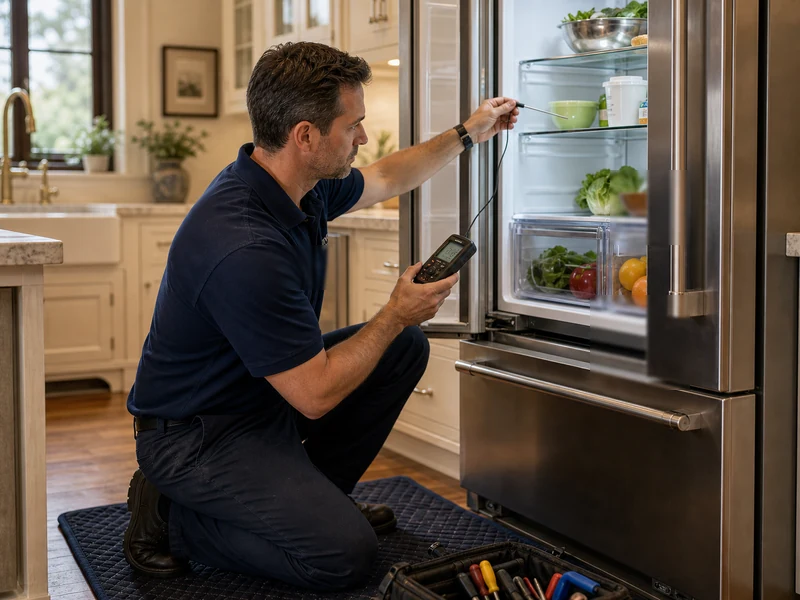
Technician logging fresh-food compartment temperature on a Sub-Zero BI refrigerator in a Julington Creek kitchen

Why is my Sub-Zero refrigerator warm?

A built-in keeps two separate cooling jobs running. When only the fresh-food side warms, the fault is almost never refrigerant — it is the air moving that cold around. The fridge-side evaporator fan, its damper, or the defrost cycle that feeds it is the place we look first.

When the whole cabinet is warm and the panel is dark or showing dashes, the story shifts to power. A storm-season brownout can lock or kill the control board, and a bad EEPROM throws a double-dash display. We confirm the cause before naming a part — the full walk-through lives on the not-cooling diagnostic.

Refrigerator symptom → first check → cost lane
What you see First check on the visit Typical cost lane
Fridge warm, freezer cold Fresh-food evaporator fan and damper $300–$650
Whole unit warm, panel dark or dashes Control board and incoming power after a surge $550–$1,100
Runs nonstop, never satisfies Condenser cleanliness, then EC 50 history $250–$700
Frost only on part of the evaporator Sealed-system pressure and leak read $1,500–$3,000

Ranges include parts and labor; specialized refrigeration labor runs $150–$250 an hour locally. Every job gets a written quote before we open anything sealed.

What we actually do

The refrigerator diagnostic, step by step

  1. Pull stored error codes and read the temperature history off the control board before touching a part.
  2. Check airflow first — condenser cleanliness, both evaporator fans, the air damper, and the gasket seal.
  3. Meter the electronics: thermistors, the defrost heater and thermostat, the condenser fan triac on the board.
  4. Only if airflow and electrical pass do we move to the sealed system, with pressure and leak testing.
  5. Hand you a written quote, then repair on the spot when the part is on the truck and verify against 38°F.

Access and decision, for the homes we work in

Cabinet condition → evidence we need → service decision
Cabinet condition Evidence we gather Decision
2008–2015 BI, clean cabinet Single failed part, sealed system tight Repair — decades of life left
Surge-hit board, otherwise sound Confirmed board fault, no other damage Replace board, recommend whole-home surge protection
Sealed-system leak on an aging unit Pressure read plus cabinet and cosmetic state Walk the repair-or-replace math together

Parts & pricing

Parts we replace most on a warm Sub-Zero

A built-in refrigerator fails part by part, not all at once, which is why most warm-fridge calls in 32259 end with one component swapped rather than a sealed-system overhaul. These are the parts that come off our truck most often on a Classic BI fresh-food fault, and why each one wears out here.

Part → why it fails in St. Johns → installed cost lane
Part Why it goes here Installed cost lane
Fresh-food evaporator fan motor Bearings wear after a decade of ten-month cooling seasons; the fridge warms while the freezer holds $300–$550
Control board (EEPROM / triac) Restoration surge after a lightning outage locks or kills the board $650–$1,400
Air damper assembly Stuck or miscalibrated damper starves the fresh-food side of cold air $300–$600
Thermistor (temperature sensor) Drifts out of range and feeds the board a false reading, throwing a service light $250–$450
Door gasket Year-round humidity hardens the seal, leaking warm air and overworking the compressor $300–$500

Lanes include the OEM part and labor; the model and serial decide exact pricing, since a board for a Classic BI-42SD may not fit a BI-36U. Sealed-system parts are quoted separately, only after a pressure read.

Before you book

What you can rule out, and when to call

A few checks take two minutes and can save a service call, but a built-in refrigerator is sealed, software-controlled, and routed behind a flush cabinet, so most repairs are not DIY. Here is the honest line between what you can confirm yourself and where a technician earns the visit.

Owner check → what it tells you → next move
Try this first What it means Next move
Confirm the door fully closes and the gasket seals all around A propped door or a hardened seal can warm the cabinet on its own Reseat items; if it still warms, book a gasket check
Check the breaker and that the panel lights respond Lights on but display dark after a storm points to a board, not a tripped breaker Do not keep cycling power — call dispatch
Vacuum the lower grille area if you can reach it safely A packed condenser is the leading cause of a unit that runs but stays warm If the warmth persists, book before an EC 50 escalates
Note whether only the fridge is warm or the whole cabinet A split tells fan/damper from a deeper power or sealed-system fault Report which side to dispatch so we bring the right parts

Anything past these — a board swap, an evaporator fan behind the rear panel, a pressure read on the sealed system — needs meters, OEM parts, and a flush-cabinet teardown. When the unit runs but stays warm, do not wait it out; an unaddressed airflow problem is what turns a $300 fan job into a compressor that has run itself to death. The full symptom walk-through lives on the not-cooling diagnostic.

Related symptoms

Symptoms that map to a refrigerator call

A warm fresh-food side is the headline, but several smaller complaints land on this same service. Knowing which symptom you have lets dispatch send the right parts on the first truck rather than diagnosing twice.

  • Fridge warm, freezer still at 0°F: a stalled fresh-food evaporator fan or a stuck air damper — the most common split we see.
  • Water pooling under the cabinet: a clogged defrost drain refreezing melt, not a refrigerant or supply leak.
  • Condensation between the doors: a humidity-hardened gasket leaking warm air, often with a tired mullion heater.
  • Runs nonstop but never satisfies: airflow first — a dust-packed condenser that trips an EC 50 code before any sealed-system talk.
  • Whole cabinet warm, panel dark after a storm: a brownout-locked board — the not-cooling diagnostic walks it through.
Two faults that both warm the fridge side — how we tell them apart
What you can read Evaporator fan failure Stuck air damper
Sound from the fresh-food compartment Silent — no fan whir at all Fan still runs; cold just is not getting through
Freezer temperature Holds a clean 0°F Holds 0°F, may run slightly cold
How we confirm Clamp meter shows no fan draw Damper fails to open on command
Typical fix Fan motor, $300–$550 installed Damper assembly, $300–$600 installed

Local notes

What St. Johns does to a Sub-Zero

This is young housing by Sub-Zero standards. Julington Creek Plantation built out through the late 1990s and 2000s and Durbin Crossing through the 2010s, so the local fleet is mostly Classic BI series now reaching the ten-to-twenty-year window where boards, fans, and ice makers start to fail. That is good news on cost: these are part-level repairs, not end-of-life cabinets.

Two local realities shape the calls. The summer storm season hands us a wave of dead boards every year — a surge protector on the dedicated circuit is the cheapest insurance you can buy for a built-in. And the county draws the hardest water in the metro, 14 to 28 grains per gallon, which is why a refrigerator service often turns up a half-clogged ice maker on the same visit. We carry the common BI parts so one trip covers both.

Diagnostic case note — Durbin Crossing

Educational diagnostic scenario. A Durbin Crossing owner reported a warm fridge side the morning after a July storm; the freezer read a clean 0°F. Stored history showed normal compressor run with no EC 50, which steered us away from the sealed system. A clamp meter on the fresh-food evaporator fan read no draw — a stalled fan motor, swapped from the truck, with a temperature recheck at 38°F before we left.

Refrigerator FAQ

Questions we field on warm Sub-Zeros

My Sub-Zero fridge side is warm but the freezer is cold — what is that?

On a Classic BI that split almost always means the fresh-food evaporator fan has quit or its damper is stuck. The freezer keeps its own evaporator running, so it stays at 0°F while the fridge climbs. We confirm with a clamp meter on the fan and a temperature log before quoting — usually a fan motor, not a sealed-system bill.

How long can I leave food in a Sub-Zero that has stopped cooling?

A loaded built-in holds safe temperature about four hours with the doors shut, less in a warm Fruit Cove garage install. Move anything you cannot replace to a cooler now and call dispatch. We carry common BI fan and board parts, so a first-visit fix is realistic when the diagnosis lands on a stocked part.

Is it worth repairing a fifteen-year-old Sub-Zero refrigerator?

Most of the time, yes. A 2008-2015 BI unit was built to run past twenty years, and a fan, valve, or board swap costs a fraction of an $11,000-plus built-in replacement. Sealed-system failures are the one case we walk through carefully — the repair-or-replace math turns on the cabinet, not the badge.

Do you service the newest Sub-Zero CL and Designer refrigerators?

We do out-of-warranty work on them and routine maintenance any time. But 2022-and-newer CL, DET, and DEC units usually still carry the factory warranty, and those claims belong with Sub-Zero Factory Certified Service. Tell us your model and serial and we will confirm coverage before you spend a dollar.

How fast can a technician reach St. Johns for a warm refrigerator?

Dispatch stages off Race Track Road, so Julington Creek, Durbin Crossing, and Fruit Cove are short hops. We hold two-hour arrival windows weekdays from 7:30 to 7 and Saturdays until 2, route around the school-pickup crush, and text when the technician leaves the prior stop.

Why does my Sub-Zero run constantly but never get cold enough?

A unit that runs nonstop yet drifts above 38°F is almost always fighting airflow, not refrigerant. A condenser packed with garage dust in a CR-210 install, a stalled condenser fan, or a torn gasket pulling in warm air all make the compressor work without ever satisfying. We clean and meter airflow first; that clears most EC 50 histories before any sealed-system talk.

Water is pooling under my Sub-Zero refrigerator — is that a leak?

Usually it is a clogged defrost drain, not a refrigerant or supply leak. Defrost melt that cannot reach the evaporation pan refreezes, then thaws and runs out the bottom. We flush the drain line, check the drain heater that keeps it open, and confirm the pan is clearing. A cracked water line or inlet valve is the less common second cause we rule out.

Should I just set my Sub-Zero colder to make it run better?

No. Both compartments are designed around 38°F fresh-food and 0°F freezer, and forcing the dial lower masks a fault while running the compressor harder. If the cabinet cannot hold spec at the normal setting, something mechanical or electronic is wrong. Cranking it down on a warm fridge often just freezes the lettuce while the real problem keeps growing.

There is condensation or sweating between the doors — is the fridge failing?

Usually it is the gasket and the humidity, not the cooling. Year-round St. Johns moisture hardens a door seal after three or four summers, so warm, wet air leaks in and condenses on the cold metal between the doors. We seal-test the gasket and check the mullion heater that keeps that area dry; a $300-to-$500 gasket replacement clears most of these without any sealed-system work.

My Sub-Zero is humming louder than it used to — should I be worried?

A new hum or rattle is worth a listen but rarely an emergency. It is most often a condenser fan working harder against a dust-packed coil, or an evaporator fan bearing starting to wear. We locate the noise by compartment and meter the fan draw, then clean the coil or replace the motor. Catching it early keeps a $300 fan job from turning into an over-run compressor.
One call. A window that holds. A Sub-Zero back at 38°F and 0°F.

Weekdays 7:30 am–7 pm · Saturday 8 am–2 pm