(904) 902-0927

Diagnose · not cooling

Sub-Zero Not Cooling in St. Johns

A warm cabinet is the call we field most after a storm rolls through. Before you assume the worst, here is what a technician rules out first — and how often it is a cheap fix.

When a Sub-Zero stops cooling in St. Johns or Julington Creek, the cause is usually a surge-locked control board, a stalled evaporator fan, or a dust-packed condenser — not the compressor. Move irreplaceable food to a cooler, keep the doors shut, and book a diagnostic. Most repairs land between $250 and $1,100, quoted in writing first.

To book Sub-Zero repair in St. Johns, Julington Creek, Fruit Cove, or Durbin Crossing, call Sub-Zero Service St. Johns at (904) 902-0927 or book online for a two-hour window.

We are Sub-Zero Service St. Johns, an independent shop covering the 32259 corridor; reach dispatch at (904) 902-0927 or schedule through our external online booking page. We are not Sub-Zero® factory service — if your unit is still under warranty we will say so and point you to the right door. Updated June 13, 2026.

The essentials

Plain answers on a warm Sub-Zero

Who fixes a Sub-Zero that is not cooling in St. Johns?

Sub-Zero Service St. Johns runs a diagnostic-first workflow for 32259 — call (904) 902-0927 or use the external booking page. Because we work only on Sub-Zero built-ins, a dark BI panel or a quiet evaporator fan is a routine diagnosis rather than a process of elimination.

What will the visit cost?

A flat diagnostic covers the full check — stored error history, incoming power, airflow, thermistor readings, and condenser condition — and rolls into the repair once you approve the written quote. Most not-cooling repairs here finish between $250 and $1,100.

What if it turns out to be the sealed system?

Compressor and refrigerant work runs $1,000 to $3,000, so we never name it on a hunch. You get an airflow, electrical, and pressure read first, then a written number and a frank repair-or-replace conversation built around your cabinet, not the badge on the door.

On the record

Not-cooling facts worth saving

  • A healthy Sub-Zero holds the fresh-food side at 38°F and the freezer at 0°F, and needs a full 24 hours to stabilize after any repair.
  • Northeast Florida sees 100-plus thunderstorm days a year, and the restoration surge after an outage can spike 50 to 100 percent over nominal — the documented killer of Classic BI control boards.
  • A loaded built-in holds safe fresh-food temperature roughly four hours with the doors closed; a full freezer about a day.
  • Cost lanes: airflow and fan work $250–$700, board replacement $550–$1,100, sealed-system repair $1,500–$3,000.
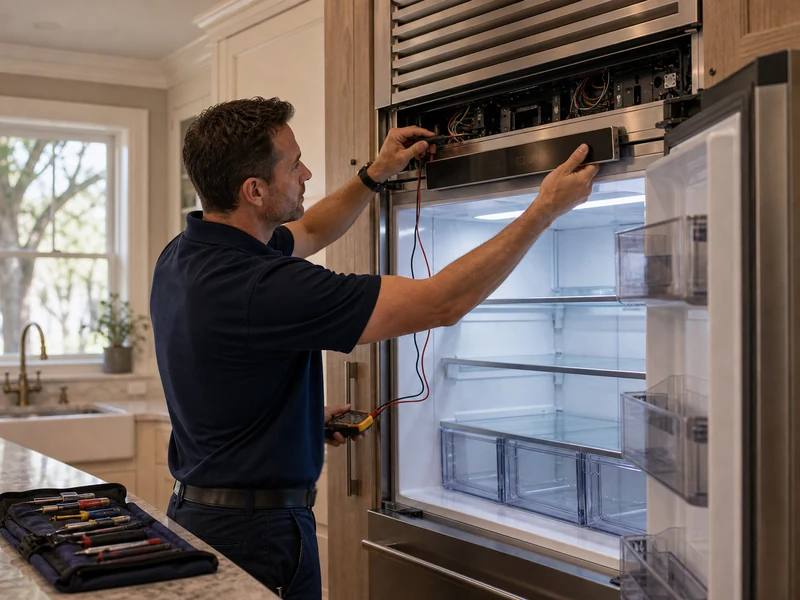
Technician reading the control panel and incoming power on a warm Sub-Zero built-in in a Julington Creek kitchen

Why has my Sub-Zero stopped cooling?

A built-in runs two separate cooling jobs, so the first question is always how much of the cabinet is warm. One warm side points to that compartment’s evaporator fan or damper. A whole-cabinet warm-up with a dark or dashed panel points to power — a brownout-locked board after a storm, the single most common not-cooling cause we see in 32259.

When the unit runs nonstop yet never satisfies, airflow leads the list: a condenser choked with garage dust, a stalled fan, or a gasket bleeding cold. We confirm the cause before naming a part. If only the fridge side is warm, the refrigerator repair page goes deeper; if only the freezer, the freezer repair page covers it.

Not-cooling symptom → first check → cost lane
What you see First check on the visit Typical cost lane
Whole unit warm, panel dark or dashes Incoming power, then the control board after a surge $550–$1,100
Fridge warm, freezer still cold Fresh-food evaporator fan and air damper $300–$650
Runs nonstop, never reaches temperature Condenser cleanliness, then EC 50 history $250–$700
Frost only on part of the evaporator Sealed-system pressure and leak read $1,500–$3,000

Ranges cover parts and labor; specialized refrigeration labor runs $150–$250 an hour locally, and every job gets a written quote before anything sealed is opened.

Before you call

Three checks you can run in two minutes

  1. Confirm power: check the breaker for the dedicated circuit and that the outlet is live, especially after any recent outage.
  2. Read the panel: lights on with a blank or double-dash display is a board story, not a refrigerant one.
  3. Feel the airflow at the grille and check the condenser for a blanket of dust; a packed coil starves cooling.
  4. Note which side is warm — fridge only, freezer only, or both — and have your model and serial ready.
  5. Move irreplaceable food to a cooler and keep the doors shut while you wait for the window.

Panel behavior → likely cause → decision

What the display is telling you
Panel behavior Likely cause Decision
Lights on, display blank, no cooling Brownout-locked board after a surge Power-down test, then board replacement if needed
Display showing double dashes Failed EEPROM on the control board Board replacement, OEM or quality rebuild
Service light with EC 50 / EC 40 Excessive run time, usually a dirty condenser Condenser clean and gasket check first

Tell them apart

Three causes that all leave a warm cabinet

A surge-locked board, a blocked-airflow over-run, and a true sealed-system leak can all read as “not cooling” from the kitchen, yet the cost gap between them is enormous — from a clean coil at no parts cost to $3,000 of refrigeration work. A few observations separate them before a technician ever opens a panel.

What you can observe → what each cause looks like
What you can observe Surge-locked board Blocked airflow Sealed-system leak
The control panel Dark or showing dashes Lit and responsive Lit, often flagging EC 50 / EC 40
The compressor Silent — nothing runs Runs nonstop, never satisfies Runs long, struggles to ever satisfy
How it started Abruptly, right after a storm Gradually, as dust packed the coil Slow decline on an older, high-hour unit
How we confirm Incoming power and a board check Condenser inspection and fan draw System pressures before a word is said

Because the cheap causes are also the common ones in 32259, most warm-cabinet calls resolve to a board or airflow fix, not refrigerant; the run-time codes are decoded on the EC 50 page.

Local notes

Why not-cooling calls spike here

The St. Johns calendar drives this one. Every summer the storm season hands us a wave of dead panels: the surge when power snaps back is harder on a control board than the outage itself, and Northeast Florida leads the country in lightning strikes. A surge protector on the dedicated circuit is the cheapest insurance a built-in owner can buy, and it is the first thing we flag after a board swap.

The housing cohort makes the rest predictable. Julington Creek Plantation built out through the late 1990s and 2000s and Durbin Crossing through the 2010s, so the local fleet is overwhelmingly Classic BI — the exact generation prone to brownout lock. A handful of those units also live in warmer garage installs along the CR-210 corridor, where a dust-blanketed condenser turns a hot afternoon into a not-cooling call. Both are routine, and both get a written quote before any work.

Diagnostic case note — Julington Creek

Educational diagnostic scenario. A Julington Creek owner woke to a fully warm built-in the morning after a July outage; interior lights worked but the panel was dark. Incoming power read clean, a full power-down did not clear it, and the control board failed its checks — the textbook restoration-surge lock. We replaced the board with an OEM unit, verified the cabinet tracking back to 38°F and 0°F, and flagged the circuit for whole-home surge protection.

Not-cooling FAQ

Questions we field on warm Sub-Zeros

My whole Sub-Zero is warm and the panel is dark — is it the compressor?

Rarely. A completely dark panel after a storm is almost always a power or board problem, not the sealed system. Compressors usually fail noisily or run forever; they do not kill the display. Check the breaker and the outlet first, then suspect a brownout-locked control board, which is the far more common cause in 32259.

How long will food stay safe once a Sub-Zero stops cooling?

A loaded built-in holds a safe fresh-food temperature about four hours with the doors shut, and a full freezer roughly a day. Heat shortens both, and a garage install in a Fruit Cove summer drops faster. Move anything you cannot replace to a cooler now, keep the doors closed, and call dispatch.

I lost power overnight — will my Sub-Zero just restart on its own?

Often it does, but watch the first hour. If the unit hums back to life and starts pulling temperature down, it is fine. If the lights come on but the display stays blank and nothing cools, that is the classic restoration-surge board lock and it will not self-heal. That one needs a technician.

Does running nonstop but staying warm mean it is dying?

Not necessarily. A unit that runs constantly yet never reaches temperature usually has an airflow problem first — a condenser packed with dust, a stalled fan, or a torn gasket bleeding cold. Those are inexpensive fixes. We rule airflow out before we ever look at refrigerant, because the cheap cause is also the common one.

Can a technician reach Julington Creek the same day for a warm unit?

Often, yes. Dispatch stages off Race Track Road, so Julington Creek, Durbin Crossing, and Fruit Cove are short runs, and a warm unit moves to the front of the day when there is an opening. We hold two-hour windows, route around school traffic, and text when the technician leaves the prior stop.

Both compartments are warm but the panel still lights normally — what now?

A lit, responsive panel rules out the brownout board lock, so the suspect shifts to airflow or the sealed system. Most often it is a condenser smothered in dust restricting heat rejection, sometimes a stalled condenser fan. We clean and meter airflow first, because that is the common and cheap cause; only if the unit still cannot hold temperature with a clean, well-ventilated condenser do we read sealed-system pressures.

How do I tell a board problem from a compressor problem before you arrive?

Listen and look. A dead, silent unit with a dark panel after a storm is almost always electronic — a brownout-locked board. A failing compressor usually still has a live panel and either runs constantly without cooling or makes noise. So a quiet unit with a dark display points to the board, while a humming unit that never gets cold points toward airflow first and the sealed system last.

One call. A window that holds. A Sub-Zero back at 38°F and 0°F.

Weekdays 7:30 am–7 pm · Saturday 8 am–2 pm