(904) 902-0927

Diagnose · EC 50

Sub-Zero EC 50 Code in St. Johns

An EC 50 on the display looks alarming, but it is the board doing its job — warning you about run time before the compressor pays the price. Here is what it means and how the fix usually goes.

On a Sub-Zero in St. Johns, an EC 50 code means the control board has logged excessive refrigerator-side compressor run time. Nine times out of ten it starts with a condenser packed with garage dust and pet hair, not a failed compressor. A cleaning and airflow check typically runs $250 to $550, quoted before work begins.

To book Sub-Zero repair in St. Johns, Julington Creek, Fruit Cove, or Durbin Crossing, call Sub-Zero Service St. Johns at (904) 902-0927 or book online for a two-hour window.

We are Sub-Zero Service St. Johns, an independent shop for the 32259 corridor — reach dispatch at (904) 902-0927 or book through our external online scheduling page. We are not Sub-Zero® factory service; on a unit still under warranty we will tell you and route the claim to Factory Certified Service first. Updated June 13, 2026.

The essentials

Plain answers on an EC 50

Who diagnoses an EC 50 in St. Johns?

Sub-Zero Service St. Johns runs a diagnostic-first workflow for 32259 control codes — call (904) 902-0927 or use the external booking page. We read the board’s stored history, not just the live code, so we can see how long the over-running has been building before we touch a part.

What does the visit cost?

A flat diagnostic covers the stored-code read, the condenser and airflow inspection, fan draw, and gasket seal — and rolls into the repair. A condenser cleaning with airflow restoration usually lands $250 to $550; a fan or gasket pushes toward the upper end.

What if it is not just a dirty coil?

If airflow is clean and the code persists, the next suspects are a failing condenser fan, a torn door gasket bleeding cold, or a drifting sensor. Each is a part-level fix, and we name the exact one in a written quote before any work, never on the strength of the code alone.

On the record

EC 50 facts worth saving

  • EC 50 flags excessive run time on the refrigerator side; EC 40 is the same alert for the freezer side.
  • Sub-Zero specifies a condenser cleaning every 6 to 12 months; in dusty garage installs the shorter interval is the honest one.
  • The field rule of thumb: an EC 50 fix nine times out of ten starts with a vacuum cleaner on the coils.
  • Cost lanes: condenser clean $250–$550, condenser fan or gasket $400–$800, sensor or board $550–$1,100.
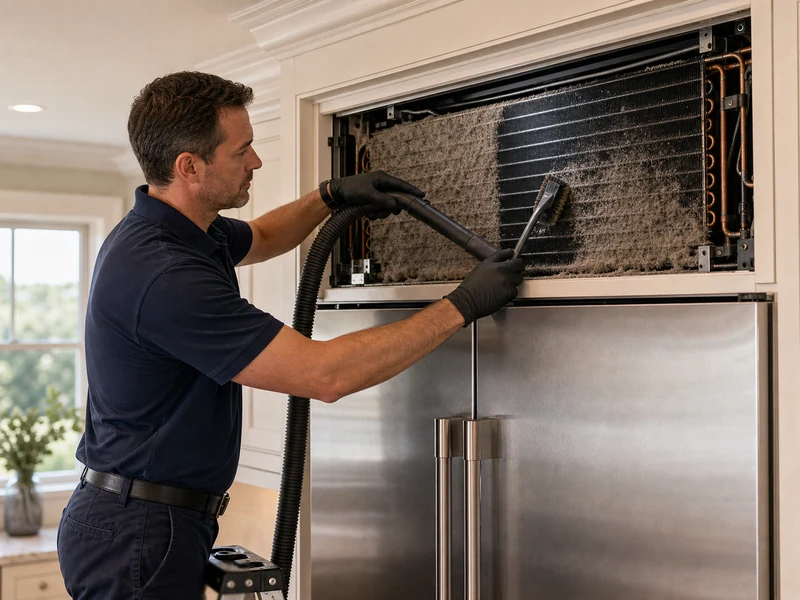
Technician vacuuming a dust-packed Sub-Zero condenser coil behind the upper grille in a Durbin Crossing kitchen

Why an EC 50 almost always starts at the condenser

The condenser sheds the heat the compressor pulls out of the cabinet. When it blankets over with dust, pet hair, and lint, it cannot release that heat, so the compressor runs longer and longer to hold 38°F. The board watches that creeping run time and throws EC 50 as the early warning — which is exactly why cleaning the coil clears the code so often.

When a clean coil does not settle it, the heat is still not leaving for a reason: a tired condenser fan, a gasket letting warm air in, or a sensor reading wrong. Those overlap with the broader not-cooling checks and the refrigerator repair page, and on the freezer side the same logic drives an EC 40.

EC 50 trigger → first check → cost lane
Likely trigger First check on the visit Typical cost lane
Dust-packed condenser coil Coil cleanliness and restored airflow $250–$550
Weak or stalled condenser fan Fan draw and bearing condition $400–$700
Torn or hardened door gasket Seal test and gasket inspection $300–$500
Drifting sensor or board fault Thermistor readings and board check $550–$1,100

Ranges cover parts and labor; we read the board history before deciding which lane applies.

What we actually do

How we clear an EC 50, step by step

  1. Pull the stored code history off the board to see how long the over-running has been building.
  2. Inspect and clean the condenser behind the upper grille, the usual trigger in dusty installs.
  3. Meter the condenser fan draw and confirm it spins freely under load.
  4. Seal-test the door gasket, since a slow leak forces the same excessive run time.
  5. Check thermistor readings, then monitor run time and verify the code stays clear at 38°F.

Evidence → what it means → decision

Reading the cause behind the code
Evidence at the visit What it means Decision
Heavy coil dust, normal fan Airflow starvation, classic EC 50 Clean coil, monitor, no parts needed
Clean coil, code returns Fan, gasket, or sensor at fault Part-level repair, quoted in writing
Code with abnormal sensor reads Thermistor drift or board issue Replace the failed component, recheck history

Related readings

EC 50 next to the other Classic BI displays

EC 50 is one of several things a Classic BI board will show, and they do not all mean the same kind of problem. Telling a run-time alert from a hard board failure decides whether the visit is a coil cleaning or a board replacement, so it helps to know what each display points to before you call.

What the display shows → what it means → where it points
On the display What it means Where it points
EC 50 Excessive run time, refrigerator side Condenser airflow first, then fan or gasket
EC 40 Excessive run time, freezer side Freezer evaporator, defrost, and airflow
Double dashes “--” Failed EEPROM on the control board Board replacement, OEM or rebuild
Blank panel, lights on Brownout lock after a surge Power-down test, then board if it stays locked

The freezer-side EC 40 counterpart is worked through on the freezer repair page; the board-failure displays are detailed on the Classic BI series page.

Local notes

Why St. Johns sees so many EC 50s

Two local realities push run time up. First, the heat: St. Johns runs a ten-month cooling season, and a Sub-Zero works harder for longer here than it would in a milder climate, so anything restricting airflow shows up as an EC 50 faster. Second, where the units live. Plenty of built-ins in Durbin Crossing and Aberdeen sit in or near the garage, where dust, lint, and pet hair pack a condenser coil in a fraction of the time a sealed kitchen install would.

The fleet matters too. The county’s housing is overwhelmingly Classic BI from the Julington Creek and Durbin Crossing build-out, the exact generation whose boards report EC 50 and EC 40. That uniformity is good news: we know these condensers, fans, and gaskets cold, so most EC 50 calls finish in one visit with a coil cleaning and a realistic maintenance interval set against the local dust load.

Diagnostic case note — Aberdeen

Educational diagnostic scenario. An Aberdeen owner reported an EC 50 with a fridge side creeping warm. The stored history showed run time climbing for weeks; the condenser behind the grille was blanketed in pet hair. We vacuumed and brushed the coil, confirmed the fan drew normally, seal-tested the gasket, and monitored a full cycle — run time dropped back to spec and the code stayed clear, no parts required, with a six-month cleaning interval set for the garage install.

EC 50 FAQ

Questions about the EC 50 warning

What does the EC 50 code actually mean on a Sub-Zero?

EC 50 is the refrigerator-side excessive-run alert: the control board has watched the fresh-food compressor run far longer than it should to hold temperature and is flagging it. It is a warning about run time, not a part number. The board is reporting that something is forcing the system to work too hard, most often poor airflow.

Is EC 50 different from EC 40?

Yes, by which side trips it. EC 50 flags excessive run time on the refrigerator compressor; EC 40 flags the same condition on the freezer side. The causes overlap heavily — a dirty condenser, a failing fan, a leaking gasket — but the code tells the technician which evaporator and compressor to weigh first.

Can I clear EC 50 myself by cleaning the condenser?

Cleaning the condenser is the right first move and sometimes it is enough, since a packed coil is the usual trigger. Vacuum the coils behind the upper grille, restore airflow, and watch run time over a day. If the code returns or the unit still over-runs, a fan, gasket, or sensor is involved and the visit is worth it.

If I ignore an EC 50 warning, will the compressor fail?

Left alone, constant over-running shortens compressor life and drives up the electric bill, so it is not a code to sit on. The good news is that catching it early usually means a cheap fix — a coil cleaning or a fan — instead of an expensive one. Addressing the airflow now is what protects the sealed system.

How fast can you get to a St. Johns home flagging EC 50?

Because dispatch stages off Race Track Road, Julington Creek, Durbin Crossing, and Fruit Cove are short runs, and an EC 50 with a warm cabinet jumps the queue. We hold two-hour windows weekdays from 7:30 to 7 and Saturdays until 2, route around the school crush, and text when the technician is en route.

My EC 50 cleared on its own — is the problem gone?

Not necessarily. EC 50 can clear once run time falls back under the board threshold, but if the underlying restriction is still there, it will return as the coil reloads with dust or the day heats up. We read the stored history rather than the live code, so we can see whether run time is genuinely back to spec or just dipped below the alarm line. A code that comes and goes is worth a look.

Does a hot St. Johns garage install make EC 50 more likely?

Yes, noticeably. A built-in in or near the garage faces both more dust packing the condenser and higher ambient heat the compressor has to work against, and our ten-month cooling season stretches that load across most of the year. Those installs trip EC 50 sooner and need a shorter cleaning interval — often every six months rather than the standard twelve.

One call. A window that holds. A Sub-Zero back at 38°F and 0°F.

Weekdays 7:30 am–7 pm · Saturday 8 am–2 pm